Sunday, 14 February 2016

Working with Tension and Time: Maria Cruz’s One Million Dollars

'Maria Cruz: One Million Dollars', Artspace, Sydney, 27 September to 21 October 2006, originally published in Artspace Projects 2006, Artspace, Sydney, 2007, pp. 101-8 (and swiped from Maria's website).

Maria Cruz, One million dollars
Installation view, Artspace, Sydney, 2006
In his first major work, Giorgio Agamben sought to explore the peculiar duality in the thinking of art, the doubling that takes the form of a split between poiesis, making, the production of sense, and aesthesis, sensing, the apprehension of sense; that is to say, between art as the creative activity of the artist and art as it is experienced by the spectator. And while it was principally the more violent manifestations of this split that Agamben, invoking the principle according to which ‘it is only in the burning house that the fundamental architectural problem becomes visible for the first time’, dealt with as a means of glimpsing the original project of Western aesthetics, the suggestion remains from his analysis that the tension between poiesis and aesthesis is common to all artistic works; certainly to their presentation, their potential to be encountered. Maria Cruz’s One Million Dollars project, undertaken at Artspace as a studio residency and gallery installation in 2006, represents a single instance that might be considered illustrative in this regard; exemplary, perhaps, because of the subtle way in which it dramatises what Agamben describes as both the ‘speculative centre’ and the ‘vital contradiction’ of art in our time.

To the casual viewer, One Million Dollars consisted of three physical elements staged in a gallery setting. The dominant element was an entire wall layered from floor to ceiling with overlapping black and red dots applied in heavy acrylic, each around two centimetres in diameter, arranged in accordance with no visible system. In the centre of the space, brightly coloured party lights dangled from the roof beams; the bulbs themselves had been crafted haphazardly from some rough material and hand painted, but their fixings and the electrical cord that strung them together were authentic and, one would assume, operable. On the gallery’s front desk, which also occupied the space, sat a stack of photocopies of a paint-stained two-page spread from a graph-ruled notebook, handwritten entries listing nothing more than dates and a series of numbers: ‘Sept 9. 280, 920, 200, 134’; ‘Sept 10. 528, 528, 528, 945, 870’; and so on.

The immediate correlation between the three elements, other than their spatial convergence, was an aesthetic consistency. They shared the same pure hues, the same plasticity, they were each ‘painterly’ in the broad sense that they bore the trace of the artistic gesture — they were discernibly products of the same artist. There was little attempt at artifice, no apparent desire to appear polished or prefabricated, only the minimum requirement that they maintain their form for the duration of the exhibition, and that, like stick figures, they act as shorthand ciphers for what they were intended to be, or rather, to represent, where representation might be required. But at the same time the presentation was sparse, considered; it lacked the overloaded anti-aesthetic sensibility of the sort of process art that seeks to resist or otherwise deflect its inevitable manifestation as sense-producing data. The selection of elements appeared specific, as if anything superfluous has been edited out. Their configuration in the space may not have been particularly legible insofar as no meaning or intention was immediately conveyed, but there did appear to be a particular logic to their inclusion. Each had a reason to be there according to a certain teleology: it had a purpose. As much as it was indisputably an object, One Million Dollars was also, quite clearly, a project.

Looking back over Cruz’s recent practice, we can see that this duality between project and object, between work as labour and work as product, is far from uncommon. The most significant — or, more properly, sustained — outcome of this tension, if we are to consider it as dialectically generative, has been the enormous quantity of Yoko Ono paintings that Cruz has dedicated herself to producing since 1999. In this series, each title of Ono’s recorded output is rendered in two colours in simple sans-serif capitals on the unadorned ground of its own discrete, modestly scaled canvas. While these are reasonably strict parameters, the artist’s means of addressing them has varied playfully over time. In the first major presentation of these canvases, 2000’s salon-style Feeling the space, Cruz confronted viewers with a rich wall of colour, the juxtaposition of contrasting hues producing quite striking optical effects. Just over a year later, The hard times are over offered a more restricted pallet, reds and blacks on white whose economy privileged the evocative language of the song titles over their visuality, but whose constructivist genealogy implied that they be read within the broader context of art history.

These shifts suggest that the orientation toward process in Cruz’s practice is more pragmatic than programmatic. On the one hand, many artists have insisted that instituting a framework facilitates production insofar as aesthetic decisions only have to be made once. In the case of the Yoko Ono works, the subject matter, general form and individual titles are determined in advance, and while the quantity is not fixed — Ono has released more recordings since Cruz’s project began — it is still, to some extent, beyond the artist’s control. But on the other hand there is no direct elision of the aesthetic, of the work’s function as a sense-producing object. Like the rules of a game, Cruz’s parameters create a space for play, allowing the artist to engage with the sensuousness of the mark-making process without denying the viewer the opportunity to do the same. As Robert Ryman once put it in relation to his own evacuated canvases, such play-tactics within strategies of reduction allow for ‘clarification of nuances in painting’. In Ryman’s terms, the question is not what to paint, but how. And while this process is geared towards production, there is no attempt by the artist — by Cruz or indeed by Ryman — to channel that production away from its ultimate manifestation in the form of an object, an encounter, a thing.
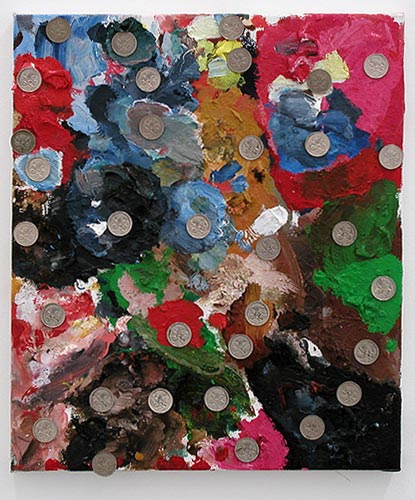
Maria Cruz, Palette (with coins) 2002
Oil on canvas, Australian 5 cent coins, 35.5 x 30.5 cm
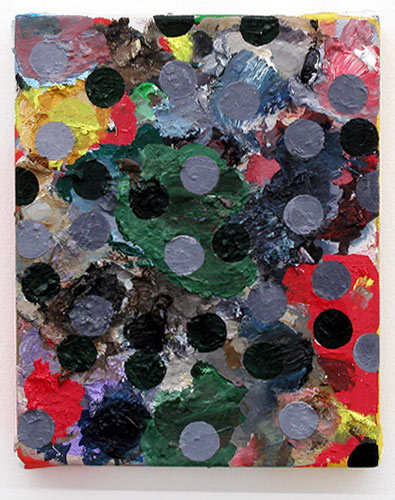
Correspondingly, Cruz maintains an awareness of the symbolising function of her work, even when working non-figuratively. This is best illustrated in the series of paintings that served, appropriately enough, as the means by which the productive framework for One Million Dollars was developed, and it is here that we might begin to understand the logic behind this last work’s material realisation. Undertaken in close parallel to the Ono canvases, both chronologically and conceptually, these works in turn find their point of departure in three small paintings produced in close succession between 2002 and 2003. The first, Palette #2, consists of a ground of heavily textured hues resembling an artist’s palette — one of the tools utilised in the work’s production — onto which are placed thirty-three Australian five-cent coins. The second, Palette #7, duplicates the relationship between a daubed, polychromatic ground and an overlay of circular, coin-sized forms, but is executed entirely in paint. The appearance of the disks that make up the painting’s foreground is clearly derived from the coins in Palette #2, to the point of their black, grey and virescent hues alluding to the unique grubby lustre of the five-cent pieces, but their surfaces reveal no face value, only traces of painterly gesture with no obvious reference to their formal origin. A third, untitled, painting from 2003 discards the palette ground entirely, the artist having opted instead for a flat base onto which the disks are applied thickly but evenly in such a way that each forms a discrete, monochromatic plane. While the restricted colour range of the preceding work is retained, the green in the third work is more pronounced, and it is presented in several different but clearly defined shades that substitute the grubbiness of the coins for the luminosity of pure hue.

Maria Cruz, Palette (traces of coins in grey) 2002
Oil on canvas, 25 x 20.5 cm
Over the course of the three paintings, we see a shift from the use of painting as a mimetic technology, as a process that would represent or refer in some way to the coins, toward a foregrounding of the abstract sensuality of the paint itself. This aspect is emphasised by the edges of the disks actually overlapping in the final work with no dilution or mixing of shades, an effect that could only be achieved by allowing each successive layer of paint to dry completely before another is applied. Through the use of this method, the artist introduces to the work a depth of field, but also — and inseparably for the viewer — a temporal aspect, a simultaneous privileging of the visual and a sense of time spent in the production visual, which when combined characterise the artist’s activity not as painting something, but as painting as such.

What makes the differences between the three works more pronounced, however, is that Cruz’s practice does not deal exclusively with abstraction; indeed, a good deal of her work is testament to her skill as a figurative painter. This is not a general shift away from representation, but a particular one, and could only have been prompted by a realisation arrived at in the course of presenting the first work. And that is that money, while an object like any other — or, to be precise, a quantity of metal with a fixed weight — has, at least in the context of liberal-capitalist society, a signifying function that is not only excessive, as with all signification, but irreducible — an excess that no recontextualisation can alter — and that, for an artist interested in dealing exclusively with its formal qualities as an object, systematic abstraction is the only option short of total revolution.

What is this irreducible signifying function? We know from Marx that the substance of value is labour, that the value of a given commodity, when brought to exchange, is determined not by its usefulness but by the amount of abstract labour-time, the average unit of total sensuous human activity, expended in its production and distribution. This, perhaps the most contested of Marx’s theories — insofar as critiques of Marxism are actually directed at the work of Marx himself — should not be construed as a simple economic proposition but as a social one. As an exchange value, the commodity is at once the physical embodiment of a certain social relation between producers — between, putting it very crudely, property owners and propertyless workers — and the concealment of that relationship. It is the appropriation of the productive capacity of humans made rational, ‘the definite social relation between men themselves’ assuming ‘the fantastic form of a relation between things’. Money’s irreducible excess of signification lies, therefore, in its role as universal equivalent, as the commodity form par excellence, standing in for all other commodities as the social incarnation of human labour and the ultimate manifestation of the activity of alienation that labour constitutes (which of course for Marx represents the appropriation of humanity’s very essence).

If Cruz’s strategy of introducing practical parameters to reduce the number of necessary aesthetic decisions is understood as a decentring of ‘the primacy of individual subjectivity as the locus of art production’, as it was for the early conceptual painters, then it is appropriate that the artist should also problematise the metaphorical aspect of the art object. Rather than originating in a rhetorical denial that such a function is possible, however, the process of abstraction as seen over the course of the three coin paintings instead demonstrates a tacit acknowledgment of money’s irreducible excess of signification, an awareness that dealings in the metaphorical, especially in such loaded territory, have the capacity to be wildly misread, forcing the responsibility for aesthetic judgment back on the artist and postponing further artistic production until such judgments can be made.

Of the three coin paintings, it was the third that would serve as the template for the body of work that would develop out of this process, representing the point at which the artist found her parameters comfortable enough to institute a new system of making. While the shape and size of the small circles that are central motif of these subsequent works hark back to the coins from which their forms were derived, reference to the social and cultural significance of this originary material is kept in abeyance, with the artist effectively excluding it from the visual field. Furthermore, the works’ titles — One Thousand Nine Hundred Seventeen; Eight Hundred Forty Five; Three Thousand Twelve — are little more than reflexive allusions to the process of the paintings’ construction, announcing nothing more than the total number of ‘dots’, visible and hidden behind others, contained within their individual pictorial planes.
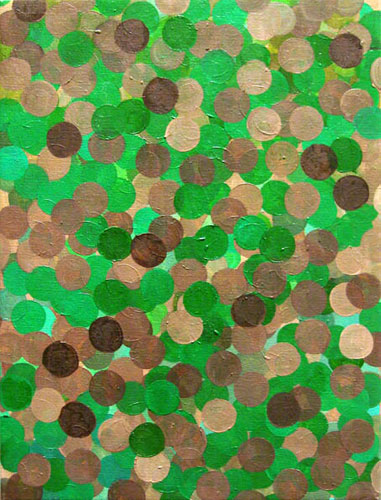
Maria Cruz, Three hundred forty eight 2005
Oil on primed lined, 40.7 x 31 cm
Exclusion, though, is never absolute. Whatever is excluded must bear a relationship to that which it is excluded from (or which excludes it), and in the necessary reciprocity of this relationship there is a paradoxical inclusion in the form of immanent potentiality. A thing is included insofar as it is not. Thus, the elision of the signifying power of money haunts the body of work that proceeds from the first coin painting as an unresolvable tension, regardless of the individual characteristics of the objects themselves: they are products of a project from which it has been consciously excluded. Importantly, though, this is a tension that can only be felt by the artist as definer and executor of the project, and only understood by the informed viewer as witness to that definition and execution; the objects themselves do not betray it. And so to the two tensions already underlying Cruz’s practice — project and object, inclusion and exclusion — is added a third, that between making and sensing, between poiesis and aesthesis.

It is possible that these hitherto subliminal tensions within Cruz’s practice emerged because of the gravity of the project. One Million Dollars marked both the culmination of the process developed in the coin paintings and a substantial shift in its articulation. While the earlier paintings had sat discretely within the frame of small canvases, all of which were well under a metre square, the painted component of One Million Dollars occupied an entire wall almost six metres long and over three metres high. Moreover, the work could in no way be considered as painted component alone, accompanied as it was by a sculptural element, the string of roughly crafted party lights, and a documentary element in the form of the stack of photocopied workbook pages, and therefore could no longer be considered as simply pictorial, but as spatial, temporal and discursive.
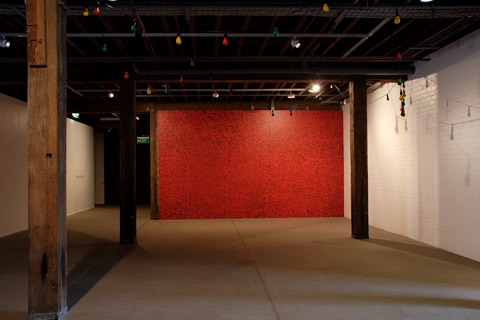
Maria Cruz, One million dollars
Installation view, Artspace, Sydney, 2006
If we are to follow the logic behind the quantitative titling of the coin paintings, the sampling of diaristic entries in the workbook could be read as a register of the number of dots painted in each session, emphasising the sense of temporality already present in the layering of different colours. As the record of an activity, the photocopies performed a second, related operation as a kind of Brechtian Verfremdungseffekt, albeit an obliquely poised one, geared toward demystifying the physical processes behind the work’s fabrication — an afterthought, perhaps, but a significant one. Most pointed, however, was the return the excluded signifier, money, physically in the poverty of form of the party lights — self-consciously cheap approximations of a cheap emotional effect — and discursively as outright acknowledgment in the project’s title. Each small red or black disk being roughly the size of an Australian one-dollar coin, the work was, tautologically, one million dollars. Or at least it aspired to be one million dollars; the amount has too much cultural resonance, acting still, in spite of inflation, as the figurative horizon of wealth to the non-wealthy, to have been arrived at after the fact by Cruz, as a precise representation of the quantity of dollar-sized circles making up the wall painting. In any case, the sheer scale of the work, the overlapping layers of paint and the limitations of the selection from the artist’s workbook — it is clear from the page that it only covers a short period of the time invested in the work — mean that there is no way for the uninformed viewer to know whether exactly one million dots were actually painted, or even how close the artist came to that figure.

Here again we find the work’s dramatisation of the split between art as experienced by the artist and art as experienced by the viewer. By presenting the diary excerpt, whose suggestion that the object is also a project ironically also presents the project as an object, and by confronting the question of value through the work’s sculptural element and its title — which is itself both proscriptive and elusive — Cruz placed her creative activity as an artist on the same plane of visibility as the product of her labour, but did not, could not, provide access to the authentic experience of that activity. Instead, One Million Dollars operated as a zone of indistinction between poiesis and aesthesis, between the provision of sense and its apprehension, painting as performance performing as painting. And located within this zone, hovering there still, were those questions, ever-present even in their absence, of value and work — work as labour, as product, as creative activity, work as the operation of the work, as the creation of human essence and its appropriation and alienation — frustratingly, yet tantalisingly, unanswered.

Tuesday, 12 January 2016

Fragment: Mladen Stilinović

Bad Art Writing has given me cause to explore the darker regions of my hard drive, where I keep finding fragments like this one from mid-2011.


Within the small but extraordinarily fertile artistic milieu of 1970s Yugoslavia, Mladen Stilinović found a means by which to unassumingly and not unamusingly highlight a revolutionary intellectual pretence of staggering — and, I submit, unflagging — absurdity, that of a hierarchy of colours. Even in the most radical of modernisms, red and black had been afforded a status apart, a symbolic value of mythic proportions imbuing a self-belief of historically determined, even messianic, revolutionary inheritance. Pink, meanwhile, was utterly marginalised, too girly, too queer, too impure to qualify as anything more than decorative or pretty. So what does dissolving the chromatic classes do, as Stilinović does? On one hand it suggests that there is a relationship between the two, and that this relationship is direct. On the other it demonstrates that this relationship is disempowered, indeed totally muddled, when the two classes are presented together, that there is no immanent reason for the their role in the absurd hierarchy, that as with all class divisions, inheritance relies for its privilege on a specific set of political associations. And, rather hilariously, these are classes that can have no impact on the form of those political associations — or, indeed, any interest in them.

And there is a footnote to the sentence on red and black:

As hyperbolic as this may sound, the unimaginative decision of ‘the largest radical publisher in the English-speaking world’ to brand its ‘Pocket Communism’ series in precisely these shades speaks volumes for their appeal to the petty narcissisms of the libidinal economy of political economy

Sunday, 10 January 2016

Yayoi Kusama: Tenacious beauty

This was the cover story for the July – September 2012 issue of Flash Art, for which I was never paid, despite some persistent hectoring and invoicing on my part. I've been stiffed a lot before, but never by such a big name. Turns out it's had a second life on the internet, surfacing from time to time on social media – you can find it at their website. 

The Obliteration Room (2011). Installation at the Gallery of Modern Art, Brisbane. Courtesy the Artist and Ota Fine Arts, Tokyo. Photography by Natasha Harth.
For a woman of 83, you could say that Yayoi Kusama’s moment has been a long time coming. It’s not that she’s been particularly unsuccessful or insignificant until now, rather that throughout her sixty-plus years of exhibition practice, Kusama has always seemed curiously — fascinatingly — out of step with her times. While associated with numerous developments in international art from the postwar period to the present day, she has somehow eluded shorthand art-historical description as a minimalist, a Pop artist or a conceptualist, a fate that has befallen many of her illustrious friends and contemporaries: Donald Judd, Andy Warhol, On Kawara. For decades this meant that she was commercially overlooked and written out of an art history that she helped construct, while her struggles with the social conditions of her identity — as a woman artist, an Asian artist, an artist living with mental illness — are well documented. But it is arguably because of her consummate ‘insider-outsider’ status, coupled with an astonishing output and a consistently experimental approach to a bewildering array of media across a range of cultural fields, that she has managed to combine popular appeal with art-world credibility. She has achieved the rare position of having both historical and contemporary significance.

And so it is that in the seventh decade of her practice, Kusama’s moment has finally arrived. With a full career retrospective due to open at the Whitney after iterations at the Reina Sofia, the Pompidou and the Tate, on top of museum-scale exhibitions of new work in Australia and Japan, solos with Victoria Miro and Gagosian, regular appearances at art fairs and biennales worldwide, and a much-vaunted collaboration with Louis Vuitton, all taking place in the last twelve months, the artist, and her profile, show no sign of slowing down. Her aesthetic, forged in traumatized post-war Japan and the avant-garde of ’60s New York, demonstrated its extraordinary currency and public accessibility when The Obliteration Room (2011), an interactive work that Kusama had designed for children, became an international Twitter phenomenon in January. While all this is cause for a certain celebration, the degree of public visibility also allows for critical reassessment of the artist and her work, accounts of which have been necessarily partial, focusing on particular periods of her life, most often her furiously inventive New York years, or aspects of her identity, intriguing biography or formidable media persona.

Happening “Love in Festival” (1968). Organized by Yayoi Kusama in Central Park, NY. Courtesy Yayoi Kusama.
In this respect, it is informative to track the various critical frameworks through which the artist’s work has been read. Kusama’s early, modestly scaled watercolors operated within the general discursive territory in which the nihonga (literally “Japanese-style painting”) of her academic training intersected with idiomatic Japanese surrealism, re-emerging after suppression during the ’30s and ’40s, and a fascination for American Abstract Expressionism. Interestingly, two of her earliest champions, Shiho Nishimaru and Ryuzaburo Shikiba, were psychiatrists. On relocating to the United States in 1957, first to Seattle, then to New York several months later, Kusama’s work underwent a profound shift in palette, scale and composition under the influence of first-hand encounters with the canvases of Mark Rothko and Barnett Newman. During this period, her work tended to be discussed in the typically modernist terms of its formal innovations as it evolved from her iconic net paintings through soft sculpture to installation, performance and happenings. Gradually leaving the art world to embrace street protest, the sexual revolution and popular culture in the late ’60s, tabloid scandal and titillation became the order of the day, before her return to Japan in the mid-’70s found a critical community unable to assimilate her work with the developments of that country’s own turbulent sixties. This combination of popular sensationalism and critical ambivalence has been cited as one of the factors leading to her subsequent mental breakdown, and she faded from the view of the West.

Kusama’s “rediscovery” fifteen years later found enhanced focus on her role as a racial and sexual other in the Green Gallery circle of the late ’50s and early ’60s, with particular attention to the generative effects of her illness on her work. Standard accounts posited her all-consuming nets and especially her trademark polka dots as inspired by and even direct representations of hallucinations suffered during childhood, which were attributed to an unhappy family life. Japanese criticism, on the other hand, has tended to concentrate on the richness of Kusama’s practice, which, by the end of the ’70s, had taken a literary turn, the artist producing numerous volumes of poetry and prose in addition to ongoing work in painting, sculpture, print-making and collage, supported throughout the ’80s by such pioneering Tokyo spaces as Fuji Television Gallery and the Hara Museum of Contemporary Art. Kusama herself has had much to say about her influence on numerous major figures in American art, among them Donald Judd, Andy Warhol, Claes Oldenberg and Lucas Samaras, while asserting her relevance as a contemporary artist and no mere historical curiosity. More recently, her verve for self-promotion, collaborations with fashion houses and merchandisers, and made-to-order works of spectacular scale, have seen her grouped alongside those great marketers of contemporary art Jeff Koons, Damien Hirst and Takashi Murakami.

While all of these perspectives shed light on aspects of Kusama’s work, they are insufficient in isolation to account for the totality of her practice. Nor do they fit together particularly well; in combination, they often reveal more about the position from which Kusama is seen that they do about her art. The picture is further complicated by contextual and historical factors. For instance, Kusama was not the only Japanese avant-garde artist to spend time in the United States in the mid-twentieth century: Yoko Ono had been living in New York with her family since 1952, Ay-O and Tadaaki Kuwayama arrived in 1958, Shusaku Arakawa in 1961 and On Kawara in 1965. For its 1965 survey “The New Japanese Painting and Sculpture,” MoMA managed to conduct studio visits with over 100 New York-based Japanese artists. Kusama also had the singular distinction of being active in Europe as well as the US, through her association with the concrete art and “new tendencies” avant-gardes Nul, Zero, Azimuth and the French Nouveaux réalistes. These connections not only enrich considerations of the optical and spatial complexity of her work; the Duchampian exploitation of artistic persona by Yves Klein, Piero Manzoni and Kusama’s sponsor and collaborator Lucio Fontana offer interesting perspectives on the development of the artist’s image as a recognizable icon. In addition to an exhausting commitment to studio practice, Kusama maintains fastidious control over any work requiring fabrication, as she does with her various commercial collaborations, despite having lived as a permanent psychiatric patient since 1977.

I’m Here, but Nothing (2000). Installation view at 21st Century Museum of Contemporary Art, Kanazawa. Courtesy Yayoi Kusama.
Given that it features so prominently in her life and work, Kusama’s mental state is worth addressing in relation to her practice. Her illness, which emerged in childhood, has been diagnosed as depersonalisation syndrome, a severe dissociative disorder that can result in episodes of detachment and anxiety, as well as obsessive-compulsive disorder. Assessment of the relationship between the artist’s illness and her work has shifted over the course of her career, both on the part of critics and historians, and by the artist herself. In addition to the argument that her visual motifs are attempts to picture psychic trauma, Kusama’s work is often thought to be a product of her obsessive disposition, which would account for its repetitive, labor-intensive character, as well as being a therapeutic outlet for her suffering. More recently, however, Kusama has suggested that her condition, at least in its current manifestation, is as much a product of her work, possibly due its proximity to the core of her practice. Whatever the case, illness provides an unstable framework for interpretation.

Nevertheless, there is something decidedly contemporary about the collocation of personal trauma and aesthetic sublime in Kusama’s work, even if her internal suffering manifests only as temporary visual or spatial disturbances in the viewer through assured games of color, contrast, line, light and scale, not to mention uncanny organic and sexually suggestive structures and compositions. Her recent work is most fully realized in this regard, and makes a compelling, if unconventional, standpoint from which to view her earlier production. Frequently participatory and physically or perceptually encompassing, Kusama’s work appears to have long anticipated the politics of spectacle underlying much contemporary museum display, as immersive and interactive art become the order of the day. But for all its phenomenological effectiveness, it is arguably the warmth of Kusama’s work, its little idiosyncrasies, its endearing oddness that causes the crowds and the critics to return to it. In this sense, it is telling that the two artists Kusama cites as most influential on her work are not Judd and Warhol but her early mentor, Georgia O’Keeffe, and her lover of ten years, Joseph Cornell: figures similarly close to the art of their time who ultimately deny easy categorization. The greatness of van Gogh, Kusama has written, lay not in his demons but the “tenacious beauty” of his art. This, then, is an artistic intention worth bearing in mind when taking this moment to look back over Kusama’s vast and incomparable oeuvre.

Saturday, 9 January 2016

Foreword: Column 6

Totally forgot I wrote this. From Column 6, late 2010.


Nuts. Almonds to be precise. Almonds in a spa bath. Quoting Andy Kaufman. As you do.

Wilkins Hill have always frustrated potential interpreters, even angered a few, with the wilful opacity of their work, its determination to evade those systems of exegesis that have become heuristic habit. What do the almonds/Kaufman say exactly? ‘Whatever is unknown is magnified.’ The spa bath picks the reference and concurs with the epistemological dictum. And why not? After all, a viewer — let’s say they’re an art critic, always the first audience, at least insofar as the generally accepted topography of the art world is concerned — stands before the object, attempting to render its unknown operation known, only to find that the object refuses to be understood. The garbled, machine-translated, speak’n’spell artist statements are no use; they’re as bad as the work, part of the work. It's an obstinacy that presents itself as unknowability, knowledge that cannot be internalised, or worse: no knowledge to be internalised, nothing to know, pure exteriority of being. It just gets bigger and bigger. Meanwhile Heidegger looks on from his hut, gazing through a distorting field of glass bricks, through whose material opacity he recognises the age-old spinning of the hermeneutic circle, and thinks about getting back to work.

In this sense — perhaps the only sense that might be made of it short of sampling an almond or two — Wilkins Hill’s Windows impersonating other windows, presented at Artspace in March and April of 2010, epitomised the problematics of writing about, around and through art. Thus the necessary partiality, the at times fragmentary nature, of the accounts contained in Column 6. Credit to Andrew McNamara for attempting to tackle Wilkins Hill’s installation for us, but their work only magnifies a condition inherent in every form of creation that exceeds linguistic expression. As with the speech-act, then, perhaps it would be better to follow the voice, a factor that forms an uncanny thread in the works and texts platformed in this issue, which draws on Artspace’s artistic program of January to September 2010. Criticism begins with the act of listening, or, more provocatively, in becoming the voice itself, or of joining it, in discord or harmony, as in Bec Dean’s sensitive and quietly agonistic treatment of Tony Birch and Tom Nicholson’s extraordinary Camp Pell Lectures. Perhaps writing, like speech, is itself a performative act, and necessarily incomplete.

Listening and performing have been crucial to Artspace’s program in the period covered by Column 6, and to point out that they have eluded the issue would be make a dramatic understatement. Though Artspace’s galleries, studios and discursive spaces have played host to elements of the Biennale of Sydney since 1996, David Elliott’s 2010 edition of the event represented the first time that the organisation had been directly involved in programming the relevant content. Artspace, Elliott and the team behind Tokyo’s vibrant experimental art venue SuperDeluxe, particularly its curator Mike Kubeck, put together SuperDeluxe@Artspace, transforming the galleries into a bar cum nightclub that played host to a veritable catalogue of live performers from Australia, Japan, New Zealand and beyond for the entire run of the biennale. In lieu of this publication’s capacity to accurately document the event in all its maverick spirit, conviviality and sonic radicality, we have opted to follow Column’s speculative agenda and commission Sean Lowry’s observations on music in contemporary art that begin this issue.

In recognising further the format’s limitations, the issue also sees greater priority given to artist pageworks as a means of expanding the possible uses of the publication. Simon Denny, Sean Rafferty and Justene Williams have each contributed significant projects to the pages of Column 6, which accompany its textual interventions as reminders of the centrality that artist’s practices have to the publication’s remit, and as exemplary propositions in themselves. Thanks is due to Melanie Oliver for her excellent work in commissioning these pages, and for collaboratively editing this issue from its inception to its realisation. Melanie has worked as Artspace’s Assistant Curator, joining its hard working and committed staff for an intense period within the organisation, to lend a steadying hand while we have been engaged in numerous activities both in Australia and abroad. Her contribution has reinforced the idea that institutions large or small operate most effectively when collectivity is embraced and ideas flow smoothly but rigorously — such is the structure necessary to a base from which a polyphony of voices might emerge.

Introduction: Column 5

Oh, I get nostalgic. Column was a journal that Blair French and I founded for Artspace Sydney, which ran to ten issues published twice yearly between 2008 and 2012. It was a flexible platform – most issues comprised essays commissioned for publication after exhibitions were presented, enabling writers and curators to engage with the material actuality of the art they discussed, alongside texts drawn form our public programming and other projects; two issues published papers from our conferences; while issue 9 was a stand-alone book accompanying the exhibition Burn what you cannot steal. I edited or co-edited the first six issues as well as Burn what you cannot steal, and particularly enjoyed taking liberties with the introduction. This foreword from issue 5 (2010) provides a pretty good sense of our projects, a rather intense program of exhibitions, residencies, conferences, symposia and publishing. I like to think of its reflections on theory as 'thinking in public' (something I also used to call 'embedded criticism') as something of a manifesto for the idea of Bad Art Writing.

Some later issues, recently.
Without wishing to become too repetitive, recent events compel us to observe once again that the socio-economic backdrop for this issue of Column is, as it has been for the past two editions, the ongoing meltdown of the financial system that has sustained the institution of liberal democracy since the dual reformation of market capitalism and Real Existing Socialism at the end of the 1980s. While the market fundamentalists and new moral capitalists bicker in their desperate scramble to shore up their defenses against the emergent threats of sovereign debt and currency devaluation, let us take the time to consider how art and artists are responding to a situation in which the internalisation of the condition of precarity has extended rapidly from individuals to enterprises to entire economies.

Column has never claimed to represent or survey the totality of art production and presentation. It is, after all, a publication whose primary role is to function as a forum for reflection on the discursive activities and contexts of a single artistic organisation and its community, activities that include the publication itself alongside the exhibitions, residencies and public programming activities. The selection of texts contained herein is by and large generated by or otherwise related to these activities, and necessarily takes them as their central focus. However, if certain threads that emerge as the texts, and the practices they discuss, enter into dialogue with one another in the context of this compendium are any indication, then certain shifts are at work within recent artistic practice, which, if not consciously developed in direct response to the economic crisis, certainly confront it in interesting ways.

It is possible to determine from the texts in this issue two key threads that have concerned Artspace and its broader community, which might be summarised in the dual sense of the term ‘autonomy’ as it pertains to art — the question of the autonomy of art as a practice distinct from other fields of human activity; and the political autonomy of the art worker, the degree to which the conditions that sustain the production of art might be determined by its producers themselves. Neither of these concerns is particularly new, and indeed they are common to many of the more nuanced understandings of the art of the past four decades. Nevertheless, it is their contemporaneity, the fact that these areas are being explored at the same moment in time, and in some cases their coarticulation, challenging institutionalised understandings of the limits and social function of art in a singular movement, that constitute fertile ground for theory and criticism, and for further practical activity.

It could even be posited that these practices are already theoretical and critical, not in the sense that they might conveniently illustrate a given idea about art, nor through the active and crucial participation of its actors in debates around contemporary art — an important function of the drive toward self-organisation — but that the works themselves effect sophisticated engagements with the ever-shifting frameworks of making and understanding art. As such they might be described as theory-producing. In testing the limits of what is understood as art, and, perhaps more importantly, of precisely how art is understood, they at once suggest the possibility of transversal exchange with other fields, and the necessity for theory, the act of thinking in public, to constantly challenge its suppositions, and to draw its energy from that which sits just beyond its grasp.
This issue of Column covers a particularly active period for Artspace, encompassing the calendar year 2009 and a very early part of 2010. Aside from Artspace’s regular exhibition program, this period saw a number of major discussion events, including a three-part investigation of organisational and institutional practices within the field of art and its various intersections with the social sphere. Beginning with the international conference Spaces of Art, whose texts comprised the fourth issue of Column, these discussions were extended and refined in the symposia One Way or Another: artist self-organisation in New South Wales and Common Knowledge: collectivity and collaboration in artistic, curatorial and critical practice. Selected texts from these programs are reproduced here. In addition to the Spaces of Art issue of Column, this period also involved the preparation of several major publications that significantly elaborate issues of relevance to the texts contained in this volume: Conceptual Beauty: perspectives on Contemporary Australian Art by Jacqueline Millner; Raquel Ormella: She went that way; and, produced in collaboration with Te Tuhi the Mark, Bruce Barber: Works 1970–2005.

A few introductory remarks are necessary with regard to certain contributions to this issue. The dialogue between Terry Smith and Rex Butler that appears in these pages is an edited and expanded version of a conversation that took place at the launch of Smith’s book What is contemporary art?, hosted by Artspace in November. In order to contextualise the discussion, which referred heavily to the book, and to a lecture given by Smith at the Power Institute the evening prior, we have reprinted a condensation of the ideas in the form of a text that first appeared in October, restoring its original title. We thank Hal Foster and the MIT Press for their permission to do so. The thirty-two-page section devoted to Imprint, curated by Anneke Jaspers with the support of the Arts NSW Emerging Curators Program, was commissioned for Column but also appeared as a self-funded standalone publication. It is intended to operate at once as a site of critical reflection on the exhibition project of the same name, as a forum for the presentation of supporting and developmental documentation, and as an experiment in using the format of publishing as a means of further extending the ideas explored in the exhibition. Finally, it should be noted the contribution of What, How & for Whom (WHW) was not developed as an essay as such, but is the text of a lecture presented as part of the Common Knowledge symposium; stylistically, it was written to be read aloud.

The contingent, performative tone of this last text is perhaps appropriate to the intentions of this publication. The texts and images contained in Column 5, are, as with each issue, reports, documents and analyses of activities that take place in the world, albeit within the capacities of a single institution. They are part of an ongoing process of dialogue and reflection that is integral to the development of Artspace’s artistic and discursive programs.

Žižek has noted of the vicissitudes of the economic crisis that ‘in late Spring 2009 it was “renormalized” — the panic blew over, the situation was proclaimed as “getting better”, or at least the damage as having been controlled (the price paid for this “recovery” in the Third World countries was, of course, rarely mentioned) — thereby constituting an ominous warning that the true message of the crisis had been ignored, and that we could relax once again and continue our long march towards the apocalypse.’ Though the Greek crisis and the panic around the valuation of the renminbi have since intervened, the case remains the same — whatever shocks may come its way, whatever gloomy prognostications are offered by the reformist Prechters, Soroses and Stiglitzes, global capital maintains an extraordinary and remarkably counterintuitive optimism about its own prospects. There is no more concrete illustration for this than the mood at a pub, situated directly behind Artspace, that is frequented by finance sector workers, presumably as a halfway point behind their jobs in Sydney’s CBD and their homes in Potts Point, Elizabeth Bay and the expensive apartments in Woolloomooloo’s Finger Wharf. Buoyant during the boom years, often filling up by 3 pm on a Friday afternoon, it fell almost completely silent in the immediate aftermath of September 2008. Slowly but surely, the bankers have returned, and with it a big-spending bravado apparently immunised against each subsequent shock. The lessons of history, it seems, can be forgotten in the blink of a dividend.

The contributions to this issue of Column and the practices they explore, no matter how specialised or episodic they may appear in isolation, collectively propose a thinking that runs counter to this blind addiction to ideology, embracing memory, processes of historical retrieval and enactment, and challenges to dominant epistemologies and hermeneutics as strategies that struggle toward an understanding of the conditions of contemporaneity, and the development of means by which to critically engage them. They are thought experiments made public, movements toward realising the political potential of art and writing, to reflect on, and to compel, action in the world.

Thursday, 10 December 2015

Studio 5, the Stars


This essay, originally published in Broadsheet, was unusual in that it described an artwork produced for an exhibition that never took place – the 2010 Scape Biennial in Christchurch that was cancelled for awful, tragic, tectonic reasons. It's probably the zenith (or nadir, depending on your perspective) of my attempted adaptation of live performance writing to gallery-based art. I know for sure that I was experiencing SNRI withdrawals when I wrote this one, which explains the quasi-libidinal referencing of authorial limitation, to say nothing of the general tone of heightened anxiety. It was written in an eight-hour burst between two Yokohama cafes, my apartment in Kannai, the office I was sharing in Hinodecho, and, finally, BankART Pub.


It’s a pretty magisterial piece of work, one that’s really going to put Christchurch on the map. A drawcard, a marquee structure, like the Sydney Opera House, or Guggenheim Bilbao—world famous, the kind of building that even the canniest tourist will photograph in order to perform their ontological function as a tourist. And not just any tourists. Art tourists. The best kind. No crass souvenir shops cluttering up the sidewalks, no—it’s Apple stores, Illy cafés and tastefully appointed bookshops all the way. Maybe even New Zealand’s first Zara. Maybe even Beams! And all for this. Gardensity. Looking like something from the Usborne cities of the future book I saved up all my pocket money to buy back in 1983. Looking downright amazing, actually. Folding the city’s extensive parkland into its functionalist centre. Taking brutalist buildings for plinths, perching on top of them artist studios, a public office, an urban laboratory, a winter garden housed in a fetching agglomeration of geodesic domes, even a visitor’s centre. Knowledge production keyed to oxygen production. Swathed in greenery, self-sustaining, entirely fictional.

Produced for Scape 2010 in collaboration with architect Dorian Farr, digital artists Patrick Gavin and Chris Toovey, and graphic designer David Campbell, Gardensity is Keating’s site-specific insertion of the field of utopian architecture into debates around urban planning. Or rather, in the ambiguity of its keynote presentation, a sophisticated virtual tour that seems to parody the medium that celebrates its subject, it is Keating’s attempt to encourage debate within what passes for debate. As with so much of Keating’s work, it is photogenic to point that its own seductiveness calls itself into question. Once again, this is Keating the performer, even if the artist is not physically present, taking his act as the embodiment of cultural contradictions, artistic conceits and flimsy democratic values to ever-greater levels of visibility within the public sphere. Sure there’s a message, a thoroughly researched and pretty-much incontestable one, but there’s a curious undertow to the spectacular tide in which Keating’s increasingly ambitious presentations would immerse us, even amidst the spume of their profuse offshoots—installations, performances, photographs, videos, more performances, more photographs, nothing wasted in the festival of waste. There is a marked lack of closure Keating’s work, clearest in its confusions of ugliness and beauty, of the anthropomorphic and the inhuman, of what is useful and what is superfluous. So much of this is corralled into affect, of course, but there is always a remainder, something integral to the work’s status art, rather than simply incidental. This is the ambiguity of the avant-gardist gesture, whether a pseudo-rational reordering or a quasi-anarchic disordering, on which his practice ultimately depends, not a corruption of language as such, but the search for a new language and, more pressingly, for a public capable of understanding it, of thinking and dreaming in it.

I first met Ash Keating in 2006, while researching a project for Artspace and the Contemporary Art Centre of South Australia that I called Publicity. The focus of my research was the intersection of artists’ practices with the public sphere, particularly those practices that stressed a continuity between public space and those normative loci of art production and exhibition, the studio and gallery. To put it another way, I was interested in artists whose work suggested that the supposedly autonomous spaces of art might be subject to the same forces as those instituted elsewhere in the public sphere, that it was a specific coding, rather than any quality inherent in art itself, which differentiated these structures from other sites of interpersonal engagement. In its capacity to reflexively deconstruct certain forms of behaviour, modes of spectatorship and patterns of communication at work in art and public space alike—or, more properly, in art as a fluid yet situationally defined subset of the public sphere—I saw in such work the promise of an agency that was qualitatively distinct from fetishisations of the studio and the gallery, either in uncritical embrace or outright rejection.

‘Intervention’ is an overused term when it comes to contemporary art. When applied to the convention of situating art in nominally public space—as a performance, say, or a large sculpture, a video projection or an architectural fixture—the word tends to overstate art’s impact, as if the work irrevocably alters the course of daily events, when in fact the reception of art of even the most radical content tends to be absorbed into the spectacle of urban geography. Curiously, just as he was equally at home in the gallery and the street, Keating seemed capable of effecting actual interventions, concretely diverting the flow of commodities and information, while constructing arresting and, despite their occasional aesthetic ‘ugliness’, ultimately edifying spectacles. Here his work suggested a second, though perhaps more elusive, continuity, that between image and action, between witnessing an event and actually taking part it, a continuity of sensorial register measured only in the proximity of bodies, those awkward, messy, desirous organisms whose coming together or apart bears scant regard for such categories as public and private, still less so that of art.

Keating had found in this zone a theatre in which ambiguity could be performed, mobilising the problematics of, among other things, a vague criminality, having made off with five percent of a free commuter newspaper’s weekly run before it could be distributed, or as interceptor of the remains of petrochemical works of art, disposed of by various institutions and headed for landfill. These materials, all too readily available as Keating had observed from his days working as a waste auditor, were then returned by the artist to the street and the gallery for appraisal, subject to certain formal shifts—ordering on the part of the newspapers, a sublime disordering when it came to former ‘ephemeral’ works of art. Suddenly, a glaring discontinuity appeared, that of liberal ethics, Keating’s two major performance personas of the time, the return-of-the-repressed garbage monster and the everyman commuter—complete with ill-fitting suit; there was a young-kid-out-of-his-depth pathos to this—bringing happy live-and-let-live morality into direct conflict with the popular ideal of environmental sustainability, superimposing two grids produced from the same notional ethical formula and finding them incompatible.

The question these actions produced might be understood as inquiring as to which grid is the more useful as a framework for action in the world. At first the answer seems simple, for isn’t ecological stability the prerequisite for material survival? There is little nobility in damning the world to death by professional courtesy. But to reduce such an urgent existential dilemma to a simple dichotomy is to overlook the specific codings of Keating’s work as art, its formal dimension, and above all its barely concealed paeans to the perfection of ambiguity. The polis, that total complex of human relations, that republic of bodies that can just as readily shit, fuck or kill, will only find grids, binaries and certainties useful until they come into contact with other grids, binaries and certainties. To be radical is to go to the root of things; clearly there is a problem with the original formula.

‘Critical Art and Metaphorical Publics’—this is one of one million self-generating back-formations posed by the Mumbai-based collective (actually ‘space’) CAMP to justify their acronym, left tantalisingly undefined. In many ways it encapsulates the forces at work in the exchanges that take place in Keating’s actions. The literal public is that which bears witness, the metaphorical public that which remains in the realm of possibility: possible past agent of repression; possible future subject of liberation. Critical art, we might say, poses the possibility of a metaphorical public; a revolutionary art would bring it into being, making it literal (to recall Ezra Pound for a moment, if only in order to forget him). The metaphorical public is not the freehold of critical art, of course; it is also—and by and large; let’s have no illusions here—the audience for the political imaginary, the dream life that hovers above every polis. We’ve been here before (me especially): Benjamin’s ‘phantasmagoria’, that phase of reification whereby the city both celebrates and obscures its origins in the consolidation of alienated labour, the aestheticisation of daily life, which makes the symbolic order a perfectly suitable field on which art might realise its critical potential, its capacity for the production of publics. Parts of CAMP’s self-description are worth quoting here as points of intersection with and clarifications of Keating’s practice:

… we try to move beyond binaries of commodity markets vs. 'free culture', or individual vs. institutional will, to think and to build what is possible, what is equitable, and what is interesting, for the future.

We wish … to consider thresholds of ownership and authority as challenging sites for art practice. To test the ground between aesthetics and multiple ideas of the public (or open), private (or closed), personal (about one's world), and power (about the world).

On the topic of ownership, then, it has to be said the littoral legality of Keating’s early actions hinges on the questions of property. When does a freely available commodity become freely available? When its producer can guarantee its advertisers that their investment will reach its target audience? How long does propriety of an item of waste extend? Until it is safely buried beneath soil it will poison for millennia? The unconscious from which the repressed returns in these cases is that of property relations, the circulation of capital and commodities that brings bodies together, stimulating and exploiting them in the sophisticated factory-marketplace we call the city, now extending, via vast communication networks, across, around and through the body of the earth, beneath whose surface, and deep in whose waters, lurk all kinds of petrochemical monsters, many of which once constituted critical and ephemeral art. Here then is another secret that Keating’s work whispers to anyone capable of hearing it, independently even of Keating himself: if there was ever a time for a thorough re-examination of Marx, for the formulation of a communism proper to the 21st century, it is now; now before the only possible form of love, of the communion of bodies and consciousnesses, is cannibalism—killing, fucking and shitting condensed into a single movement.


This, at least, is my compression of the visions of the future offered to us by a dejected Robert Smithson in 1970, and when the garbage-disposal chutes of a chic apartment block backed up in JG Ballard’s High Rise, with its frightening vision of publics constituted by compound failures of technology and architecture. One finds a compelling anticipation of these critiques in the famous lament of the ill-fated lettrist Ivan Chtcheglov, under the pen name Gilles Ivain, that when ‘presented with the alternative of love or a garbage-disposal chute, young people of all countries have chosen the garbage-disposal chute’. Chtcheglov’s solution, which would become a central part of the program of the Situationist International, at least in its formative years, was the creation of a new urbanism, an architecture that would engender new conceptions of space, time and behaviour. Chtcheglov took de Chirico’s uncanny perspective as his model; later situationists proposed de Sade, the postman Cheval, Ludwig II of Bavaria.

Naturally, Chtcheglov, confined to a mental institution shortly after, realised not a single structure, let alone the entire city he had envisaged. Nor would his comrades, the exigencies of whose times would soon lend their work a radically different dimension. It must be said, however, that this dimension was not at all an inconsistent one; here I challenge anyone bemoaning the end of the utopian period of the Situationist International to confront the Algerian struggle in all its gravity. Anyone looking for the roots of May 1968 need look no further than here. Moreover, Chtcheglov’s observation forms a certain operative core within the most advanced developments of situationist thinking, a point of departure from which a sophisticated application of the theory of commodity fetishism might be exercised. Anyone looking to understand the awesome threat posed by the environmental crisis need look no further than the riddle of the commodity.

Since its early, sometimes lonely, guerilla manifestations—one can only smile at the romantic beauty of a city wall splashed with paint of different hues each time the artist passed it as a student—Keating’s practice has grown both more ambitious and more situated. Beginning with his enormous, collaborative 2020? project at Melbourne’s Arts House Meat Market (2008), and subsequent articulations inviting other artists to participate in his ‘festivals of waste’, such as Labelland (Seoul, 2008) and Activate 2750 (Penrith 2009), Keating’s work has expanded to such a point that it is impossible to recognise him as the specific, heroic identity of his earlier performances. Is this a disappearing act or has the artist simply ascended further up the chain of command, so that like a film director we only experience his presence in cameo? But is this presence so integral to the work? After all, we don’t ask the same of a painter or a photographer; still less a filmmaker. The tension here is that after being seduced by the outsider romanticism of his earlier actions—not to mention a certain art-world notoriety as a result of his incisive critiques of the environmental effects of art production—we might find his mobilisations of bureaucratic, administrative and commercial forces to mimic precisely those forces against which he was once perceived to rally.

At this point I have to say that as much as the anarcho-purist in me would like to find this aspect of Keating’s work problematic, I simply cannot develop a critical apparatus by which to reproach his current practice. So much of what would attack it is dependent on a figure commodified to such an extraordinary degree—that of the masculine outsider—that it bears no relation to the actual form, content and context of the work itself. Other critiques, which consistently invoke the artist’s readiness to document his practice, usually evidenced by the presence of multiple still and motion picture cameras, seem to ignore certain documentary conditions of performance and to embrace, most problematically of all, the notion of the authenticity of the original event, as if Péret insulting a priest, to give just one canonical example—and one conveyed more by its caption than by the image itself—occurred without the presence of a photographer, and was inscribed in the pages of art history by the indexical magic of the revolutionary event itself, like so many shadows on the walls of Hiroshima. There are far greater forces at stake than the memory of what once was seductive.

And here we arrive back at Gardensity, a proposition that is seductive in an entirely different way. Gliding effortlessly around Christchurch’s grey-green centre to a laidback beat, we surrender, however momentarily, to the dreamlife of the polis, the possibility that the forces of capital might realise the perfect affluent city in the perfect stable social democratic nation, that we might breathe the fresh air of the southwest Pacific in a carbon-neutral, artist-friendly space, that even on waking our era will dream the next. And then we realise that we are not in the space of architecture but that of art, a slippery, ambiguous realm in which questions are posed even as they are answered. This is a building that is not. The Hacienda will never be built, and even if it were, what form should it take? What would be its impact? Who would it be for? And who, ultimately, would foot the bill, if we were to trace the base metals whose compounds make up Gardensity’s elegant framework back to their muddy, dangerous origins? This is what we want, though, isn’t it? Isn’t it? Over to you, metaphorical public.